ROB RUN server wipes: How Territory Resets Work
See how ROB RUN server wipes reshape territory, clans, and loot in a one-week crime sandbox, and how to plan each reset.
ROB RUN server wipes are the clock that turns a crime sandbox into a short season. In a city built for about 5,000 living players, a single week is pitched as enough time to climb from an ordinary thug to the boss of the largest crew on the server. Then the board clears. ROB RUN server wipes matter because land, loot, and rank are temporary, while the habits you learn are not.
That is why the reset is not a footnote. It decides whether you hoard a lavish hideout or spend the week taking territory you can actually defend. If you wait for a permanent empire, you will play the wrong game. Open fights are costly when every cop is another person, so the smart week mixes cunning with a crew you can actually trust.
Why ROB RUN server wipes set the pace
The store pitch is blunt: rise fast, then start over with sharper experience, allies you already know, and a bolder plan. A second write-up of the same idea calls the cycle a compact season. Progress refreshes. Ambition does not get a year to calcify. Conflict speeds up because nobody can sit on a district forever.
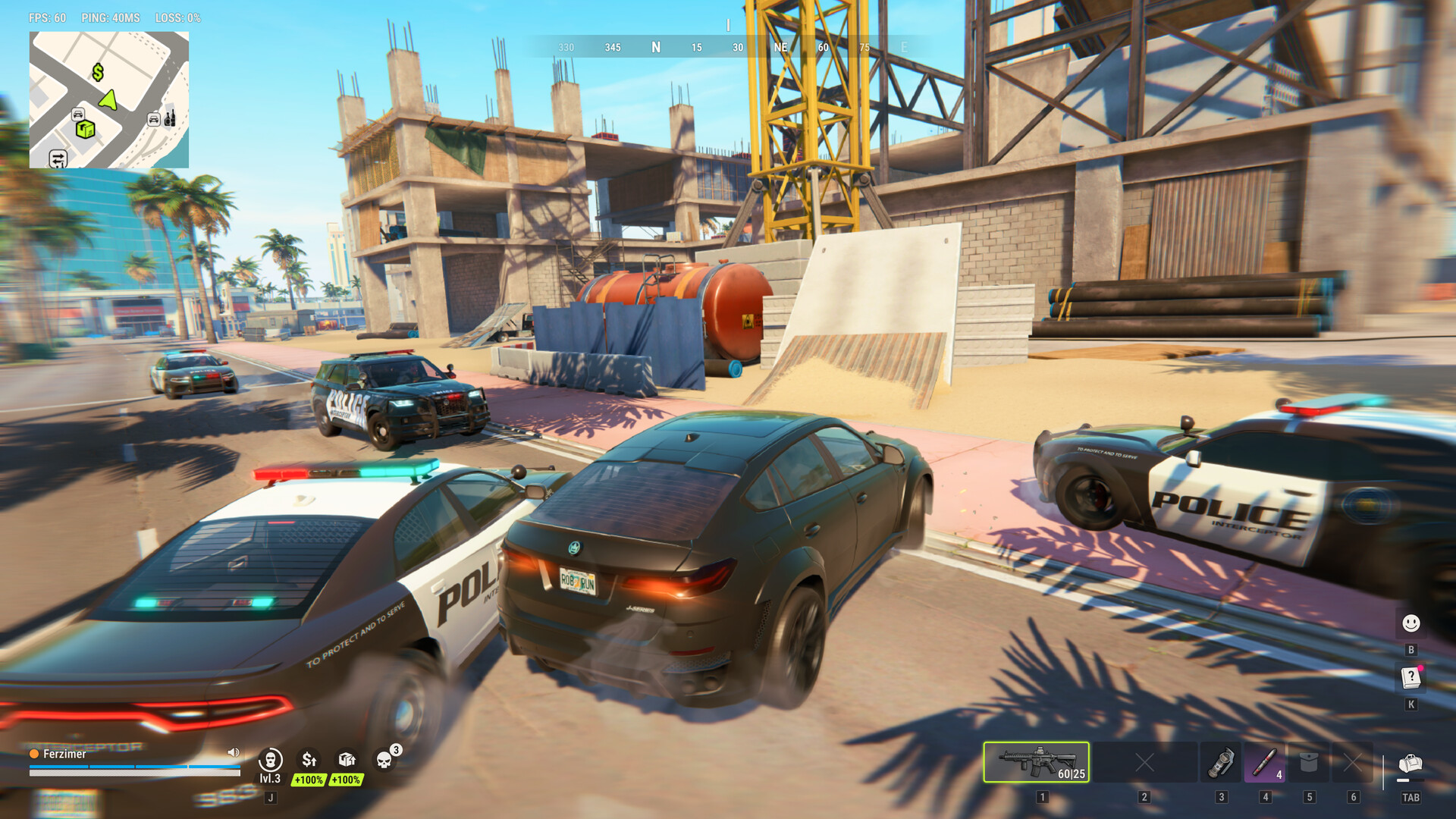
Official screenshot · Source: Steam store
There is a second clock underneath that one. You can lose gear, vehicles, and a hideout at any minute to another player, not only when the server resets. The weekly clear is the hard stop. Theft, raids, and police pressure are the soft stops that happen all week. Planning for only one of those clocks is how crews go broke on day three and again on day seven.
Official materials do not publish a minute-by-minute wipe script. They do say the fantasy is a one-week climb. Until patch notes name a weekday and a timezone, treat “about seven days” as the design target, not as a promise that every server flips at the same minute. If later community reports name a timer, check them against the developer notes on Steam before you bet a stockpile on them.
| Pressure | What it threatens | How fast it hits | What still helps next cycle |
|---|---|---|---|
| Player raid | Stash, vehicles, base | Minutes | Route knowledge, who betrayed you |
| Player police | Heat, chases, lost jobs | A single pursuit | Which streets actually break a chase |
| Rival clan war | Territory and income | Hours to days | Truce terms and role gaps |
| Server reset | Rank, land, stored wealth | About one week, per the pitch | Experience and the allies you keep |
What resets, and what territory is really for
Territory in this game is not a badge. Holding ground is described as a path to resources and influence, and also as an invitation to fight. Negotiation, truces, and betrayal sit in the same meta as shootouts. Trust is framed as more valuable than ammunition, which is a polite way of saying a loaded gun does not keep a district if your own people flip.
That changes how you read a map late in a cycle. A block you cannot garrison is not an asset. It is a travel bill and a raid beacon. A smaller slice you can patrol, stash, and exit beats a pretty border you only own on a scoreboard.
ROB RUN server wipes make a bloated claim even harder to justify. You will not grow into a sprawling border over months inside one season. You have days. Take land that pays for the people you assign to it. Leave the rest as hunting ground rather than a second home you cannot staff.
| Claim style | Upside before a reset | Failure mode | Better use of the same people |
|---|---|---|---|
| One tight district | Easier defense, steady loot | Still a target if the base looks rich | Best default for a new crew |
| Scattered outposts | Map presence, more job options | You cannot be everywhere | Temporary job sites, not homes |
| Showcase headquarters | Crafting, storage, status | Lavish refuges draw intruders | Upgrade only after you can guard it |
| No land, pure mobility | Harder to pin down | Weak say in server politics | Fine early, weak if you want to rule |
Clans are the engine for any of those rows. You can survive alone. The materials are clear that shaping the server is a group job. Create a crime family or join one, assign roles, set raid times, and decide in advance who is allowed to call a truce. A week is too short to invent your org chart during a gunfight.
Reliable allies are the asset the pitch keeps pointing at. In a city where anyone can flip, a three-person crew that shows up beats a twenty-person list that does not. Put names on jobs before you put flags on blocks.
A practical week before the next clear
ROB RUN server wipes reward crews who write the week down. Use the one-week pitch as a planning frame, not as a leaked schedule. The labels below are a player-facing plan built from the published loop. They are not dates printed by the studio.
Early push: get liquid. Small robberies, a working vehicle, and a forgettable stash beat a custom base. You are still learning who shoots on sight and which cops actually chase.
Crew push: stop soloing the jobs that need a driver, a lookout, and someone on the door. Write the roles down. If your only communication is shouting after the fight starts, you do not have a clan. You have a crowd.
Territory push: pick one area that feeds the jobs you already run. Hold it long enough to matter. Start a war only when the prize is larger than the gear you will lose if the push fails. Shootouts are part of the setting, but open combat is described as dangerous enough that sharper players look for another way in.
Final push: stop decorating. Move valuables you cannot bear to flash. Teach a backup the route you have been running alone. If allies are what the fantasy lets you carry forward, spend the last stretch on two or three relationships instead of a fourth fight.
| Push | Main goal | Concrete action | Skip this |
|---|---|---|---|
| Open | Cash, a ride, a quiet stash | One repeatable job with an exit | Custom interiors |
| Crew | Roles that survive a messy night | Driver, entry, lookout, negotiator | Recruiting anyone with a mic |
| Land | One district you can staff | Patrol times and a fallback stash | Painting the whole map |
| Close | Convert stuff into know-how | Debrief routes, name backups | A vanity raid at the buzzer |
A few rules keep that frame honest:
- Assume every parked car and every safe can vanish before the wipe, not only after it.
- Weigh a daring raid against the cost of being seen. One sloppy job can erase the week's climb.
- If a truce saves more resources than a war, take the truce. You can revisit it later. You cannot un-lose the guns.
- Debrief after failures. A dead heist that teaches a rival's response is worth more, across resets, than a lucky ambush you cannot explain.
- Keep a mobile kit. Workbenches and safes matter, but a base you refuse to leave becomes the raid you are hosting.
Read the scoreboard as a weekly story, not a lifetime rank. Someone will hit the top of the server. Most crews will not. Your win condition can be “we held one block and learned three exits,” and that still compounds.
Hideouts, jobs, and the cost of looking rich
Home is both a castle and a billboard. You can build and upgrade a hideout, store loot and vehicles, and place workbenches and safes. The same materials warn that a lavish refuge pulls intruders. Guarding it is an ongoing cost, not a one-time craft bill.
Balance hoarding and mobility on purpose. A safe full of guns you never move is a gift to the first crew that learns your door. A vehicle you actually drive is a tool. A vehicle you only park under lights is set dressing. Before you add another upgrade, ask who is online to watch it during your off hours. If the answer is nobody, you built a loot pinata.
Player raids and ROB RUN server wipes both empty a rich-looking home. One happens because someone noticed you. The other happens because the season ended. Neither cares how many hours you spent on the interior. Spend upgrade time on exits, a second stash, and crafting you will use this week.
Jobs sit on the same scale. Bank robberies, raids on rival hideouts, police chases, and street shootouts are the daily grind for resources and influence. None of them is free heat. Player police are not a pattern you memorize. A chase is an improvisation, and with thousands of people in the city it can spill into blocks you did not plan to visit.
| Job | What you are really buying | Main risk | When it fits the week |
|---|---|---|---|
| Street theft or a small robbery | Seed money and map habits | Fast loss if you linger | Opening push |
| Bank robbery | A large cash spike | Long exposure, big response | After you have an exit crew |
| Raid on a rival hideout | Their stock plus a message | Counter-raid and betrayal | Midweek, with a real reason |
| Police chase | Often nothing but survival | Total loss of the job | Only if the payoff already left |
| Truce or a back-channel deal | Time and a safer border | The other side lies | Any time open war costs too much |
Strength and cunning are both tools. Reflexes win the corner. Reading the room wins the week. Coordinate before you pull the trigger, and decide what “enough” looks like so a good job does not turn into a second, worse one.
Stories will be messy on purpose. A failed heist can start a revenge war. A clean ambush can make a small crew look large overnight. Those arcs are player-made. They also expire when the server clears, so write down what worked. Your notes will outlast the narrative if you bother to keep them.
Early Access, and what is still unconfirmed
ROB RUN is slated for a November 2026 release window and is planned as an Early Access title for roughly six to twelve months. The developers say the online game is playable at the core, still needs polish and balance, and may show bugs. They do not plan to change the price when Early Access ends. Feedback is meant to move through the Steam Community hub, Discord, patch notes, and possible polls or community tests.
During Early Access, ROB RUN server wipes are also a balance test, not only a seasonal hook. A reset in a finished live game is a product promise. A reset this early is a test of netcode, economy, and whether a one-week power curve is fun or just exhausting. Expect the details to move. More maps, characters, items, progression, rankings, and matchmaking are on the roadmap, and any of those can change how hard a clear feels.
The store page also notes kernel-level Easy Anti-Cheat, a third-party EULA, and AI use on some graphic elements. None of that names the wipe hour. It does show the studio treating fair play and presentation as part of the same early build. Read the current ROB RUN page on Steam before you buy. Early Access notes can change faster than any guide.
Minimum and recommended PCs, as listed for the Windows build, tell you whether you can even log the season. A wipe you cannot join is a wipe you lose by default.
| Spec | Minimum listed | Recommended listed |
|---|---|---|
| OS | Windows 10 or later, 64-bit | Windows 10 or later, 64-bit |
| CPU | Intel Core i5-6600K or Ryzen 5 1600 | Intel Core i5-9600K or Ryzen 5 3600 |
| Memory | 12 GB RAM | 16 GB RAM |
| GPU | GTX 1050 Ti, RX 580, or Arc A380 | RTX 2070, RX 5700 XT, or Arc B570 |
| Other | DirectX 11, broadband, 20 GB disk | DirectX 11, broadband, 20 GB disk |
Language support on the store list covers full English and Russian audio, with French, German, and Spanish (Spain) on the interface and subtitles. If your crew mixes those languages, say so when you recruit. A one-week clan dies faster on missed callouts than on a bad gun.
Until a public timer exists, the best prep is operational. Know your roles. Know one district. Know which allies you would restart with. That is the practical reading of the loop: the city takes the empire back, and you keep the lesson.
FAQ
How often do ROB RUN server wipes happen?
Published descriptions frame the climb and the reset as about one week. As of the November 2026 store material, they do not lock a weekday, an hour, or a timezone. Use the weekly idea for planning, then confirm anything more specific in official patch notes before you dump a stockpile. Treat unnamed timers from community reports as rumors until the studio repeats them.
Do bases and loot survive the reset?
The fantasy is a fresh start. Hideouts, stored loot, vehicles, and server rank are presented as part of a climb you can lose, both to other players during the week and to the clear at the end. Experience and allies are what the pitch says you carry into the next run. Do not assume a mechanical clan save until the developers document one.
Is solo play viable if territory resets so fast?
You can survive alone, and some people will prefer the chaos. Thriving, in the sense of holding land and steering the server, is described as a crew problem. If your goal is to run the largest organization on the server, recruit before you decorate. Solo play is a valid way to learn streets. It is a weak way to hold them.
Should you buy in during Early Access just to practice the reset?
Only if you want an unfinished online game. The studio says Early Access exists to test balance, netcode, and content with real players, and that the price is not planned to rise later. If you need a stable ruleset, wishlisting and waiting is the safer call. If you like shaping a season while the rules are still soft, the weekly clear is the system worth practicing first.
Related Guides
ROB RUN control of territories: Clan Power Guide
ROB RUN control of territories decides clan power, raids, and survival before each weekly server wipe.
ROB RUN GvG for territory: Clan Control Guide
Plan ROB RUN GvG for territory with clan roles, raid timing, hideout defense, and weekly wipe priorities.
ROB RUN resources and influence territory guide
Learn how ROB RUN resources and influence shape territory, clans, hideouts, and the weekly wipe before Early Access in November 2026.
ROB RUN plan: A Beginner’s Guide to Surviving Wipes
Build a practical ROB RUN plan for launch: choose allies, manage risk, develop your hideout, and prepare for server wipes.
ROB RUN closed alpha: playtest, date, and what we know
ROB RUN is still unreleased. See the Steam playtest, November 2026 Early Access plans, PC specs, and what closed alpha clips leave unconfirmed.