ROB RUN assign roles: How Clans Take Control
Learn how ROB RUN assign roles builds clans that hold territory, run raids, and last through each weekly server wipe.
In a city packed with thousands of real players, the crew that hesitates over who drives, who watches the door, and who talks to rivals is the crew that gets wiped. ROB RUN assign roles matters because open fights are expensive, cops are other humans, and a plan with no owner falls apart the second someone changes it. ROB RUN assign roles is also how you turn a weekly reset from a panic into a season you can actually win.
ROB RUN is a player-driven crime sandbox headed to Early Access, with a planned Steam release in November 2026. The ROB RUN Steam store page describes a city of about 5,000 people where every criminal and every cop is a living player. There is no scripted patrol you can memorize and no NPC backup when a deal goes bad. Clans, crime families, and loose crews are the only way to shape that map instead of merely surviving it.
That is why job design is not a forum extra. The same store description lists the clan loop in one breath: create or join a family, assign roles, organize raids, take territory, fight gang wars, and negotiate truces. Hideouts, vehicles, workbenches, and safes raise the stakes, because a lavish base paints a target on your stash. Then the server wipes. In roughly a week you can climb from ordinary thug to the head of the largest organization on the server, and then you start over with better allies and a sharper plan.
Until widespread player experience exists, treat any detailed rank list as a planning framework, not a confirmed menu. The sections below stick to systems the developers have actually described and turn them into a roster you can run on day one of a wipe.
Why a role map beats a group chat
Survival and influence are different games. A solo player can dodge a bad fight, stash a car, and scrape together another kit. A clan that wants territory has to do several jobs at once: scout a block, hit a rival hideout, keep a negotiator on voice, and still have someone home when an opportunist tests the safe. If all of those jobs live in one person’s head, the crew stalls the moment that person dies, disconnects, or gets pulled into a chase.
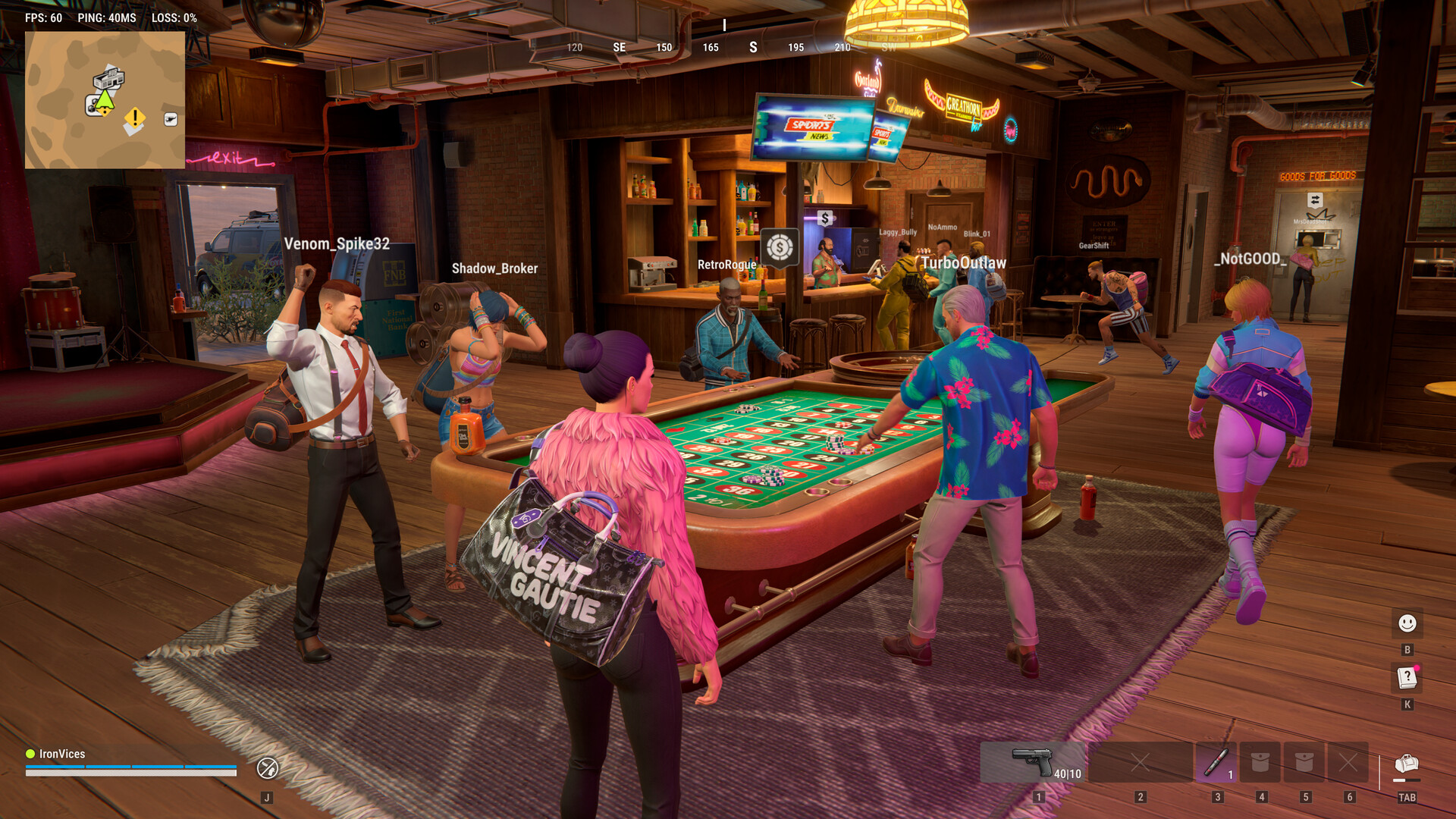
Official screenshot · Source: Steam store
Real opponents make the problem worse. A police chase is not a pattern. A rival raid is not a timed world event. Both are improvisations, and improvisation with thousands of people nearby gets loud fast. Clever players will also skip the shootout entirely and take what they want through a deal, a betrayal, or a quiet theft. Your roster has to cover guns and talk, or you will win firefights and still lose the week.
Trust is the scarce resource. Ammo can be replaced after a wipe. A member who knows the safe route, the truce terms, and where the workbench queue sits cannot. Assigning roles is how you decide who is allowed to know those things, and who is still on a trial run.
| Play style | What you can realistically do | What usually fails | Best use of people |
|---|---|---|---|
| Solo | Dodge fights, move loot, reset fast | Holding ground, long raids, diplomacy | One flexible kit and a small stash |
| Loose duo or trio | Short hits, shared lookout, quick escapes | Overnight defense, multi-front wars | Pair a driver with a shooter |
| Organized clan | Territory, scheduled raids, truces, base crafting | Slow calls, leaks, idle members | Named owners for each job |
| Bloated unlabeled group | Big numbers on paper | Friendly confusion, stolen cars, bad truces | Cut the roster or assign jobs today |
What Early Access actually promises clans
The developers say the online game is playable at its core, with balance, netcode, and content still being shaped by live feedback. They expect roughly 6 to 12 months of Early Access. The full version is planned to add maps, modes, characters, items, progression, rankings or achievements, better matchmaking, and more polish. Price is not expected to change when Early Access ends. Community contact is planned through the Steam hub, Discord, patch notes, and possible polls.
That timeline should change how seriously you treat ranks. Early Access balance will move. A role that feels mandatory in month one may be a luxury after a patch, and a job you ignored may become the whole meta once new items or modes land. Build titles around durable tasks—movement, storage, combat, talk, and base upkeep—not around a single weapon or exploit that a patch can delete.
Anti-cheat is part of the clan story too. The Steam listing notes kernel-level Easy Anti-Cheat and a third-party EULA. You cannot manage a family if members are unsure whether losses came from skill or from cheats. Make “read the EULA and run clean” a membership rule before you hand anyone a key to the garage.
| Topic | Stated plan | What clan leaders should do with it |
|---|---|---|
| Player count | About 5,000 real players in one space | Assume third parties will crash your raid |
| Climb and reset | About one week from thug to top, then a wipe | Write roles that can be restaffed every season |
| Early Access length | About 6–12 months | Review titles after major patches, not every death |
| Post-launch scope | More maps, modes, customization, rankings | Keep core jobs; add specialists later |
| Price | Not planned to rise after Early Access | Recruit on fit, not on a future paywall rumor |
| Fair play | Easy Anti-Cheat, third-party EULA | Confirm acceptance before promoting anyone |
Language support is broader than full voice acting. English and Russian are listed with full audio; French, German, and Spanish (Spain) have interface and subtitles. If your family spans those languages, put a bilingual caller on raids. A perfect shooter who cannot hear the abort call is a liability in a player-cop chase.
Minimum hardware is a 64-bit Windows 10 PC, a Core i5-6600K or Ryzen 5 1600 class CPU, 12 GB of RAM, and a GTX 1050 Ti, RX 580, or Arc A380 class GPU, plus 20 GB of disk and broadband. Recommended specs step up to 16 GB of RAM and an RTX 2070, RX 5700 XT, or Arc B570 class card. Raid leaders should know who is on minimum spec. Those players can scout or haul, but they should not be the only person rendering a dense shootout if the server is already chaotic.
A roster you can staff before the first raid
Use this as an internal org chart. Nothing here is an official rank list. It is a way to cover every activity the game has publicly described: raids, territory, gang wars, truces, hideouts, loot, vehicles, workbenches, and safes.
Keep the leadership layer small. One shot-caller owns the plan for that session. A second person, the quartermaster, owns what enters and leaves the base. Splitting “who we shoot” from “what we own” stops a hot-headed raid lead from gambling the whole safe on one push. A diplomat handles truces and should not also be the person most likely to start a war in voice chat.
| Role | Primary job | Must be able to | Should not also own |
|---|---|---|---|
| Shot-caller | Session plan and abort call | Read a fight and stop it | The only safe code |
| Quartermaster | Loot, safes, craft queue | Track what the base can lose | Live-fire decisions |
| Raider | Entry, pressure, extracts | Move and shoot as a pair | Diplomacy mid-fight |
| Driver | Vehicles in and out | Leave before the street clogs | Parking the only escape car in the open |
| Scout | Routes, cop movement, rival habits | Report without engaging | Starting the raid early |
| Diplomat | Truces, deals, war limits | Speak for the clan, then stick to it | Solo revenge after a vote |
| Base watch | Hideout defense while others are out | Delay intruders and call it in | Leaving the bench unattended “for one job” |
| Recruiter | Trial members and leaks | Cut people fast | Full stash access on day one |
Staff in pairs when you can. Two raiders, or a raider and a driver, can still finish an extract if one goes down. A single “main character” who scouts, shoots, talks, and holds the keys will look dominant until the first death screen, and then the family discovers nobody else knows the plan.
Access should lag behind trust. Community reports are not widely available yet because the game is still approaching release, so borrow a rule that holds in any shared-stash sandbox: trial members ride along, proven members touch the workbench, and only the quartermaster plus one backup touch the main safe. The official warning is clear enough on its own. Anyone can betray you, and a nicer hideout attracts more intruders. Lavish storage without access control is an invitation.
Write each title as a behavior, not a vibe. “Be aggressive” is not a role. “You open the raid only after scout confirms two exits” is a role. “Handle politics” is not a role. “You may offer a truce that lasts until the next wipe, and you post the terms in chat before anyone rolls out” is a role.
How to staff a wipe week
The weekly reset is the pacing hook. Progress, alliances, and map control all come back. That sounds forgiving. It is not, if your jobs are undefined, because everyone relearns the same failure in parallel. Treat each wipe like a short season with four beats: claim, stock, strike, and lock.
On day one, names matter more than turf. Pick the shot-caller, quartermaster, and scout before you pick a neighborhood. A territory you cannot staff is just a billboard for the next crew. Days two and three are for vehicles, a workbench, and a safe that more than one trusted person can reach if the owner is offline. Midweek is for the raid or the negotiated grab that actually changes who holds resources. The last day is for defense, debt, and notes the next season can use. Starting over is the point. Starting over with amnesia is optional.
| Wipe phase | Goal | Roles on duty | Pass condition |
|---|---|---|---|
| Day 1: claim | A meeting point and a call structure | Shot-caller, recruiter, scout | Everyone can hear an abort |
| Days 2–3: stock | One vehicle loop, bench, and safe | Quartermaster, driver, base watch | Loot has an owner and a backup |
| Midweek: strike | One raid or one negotiated take | Raiders, scout, diplomat on standby | Exit planned before entry |
| Late week: lock | Hold or sell what you took | Base watch, diplomat, shot-caller | No new war you cannot staff |
| Wipe hour | Notes, not heroics | Quartermaster records, recruiter reviews trials | Next roster drafted before queues pop |
Do not promote people because they won one chaotic fight. Promote them because they did the job you named. A driver who always leaves an engine running is more valuable across wipes than a raider who cannot resist a third gunfight on the way home. Player experience will eventually show which kits dominate, but the habit of leaving is already supported by the design: you can lose gear, cars, and hideouts in a heartbeat.
If the clan is small, merge titles instead of inventing extras. Scout plus diplomat can be one careful player. Base watch plus quartermaster can be one home player. Do not merge shot-caller and the only driver. The person deciding to stay cannot also be the person who must have the car pointed at the exit.
Raids, turf, and the talk that prevents bad wars
Territory is not a cosmetic number. Control is described as a path to resources and influence, and it invites conflict. That means every block you paint is a promise that someone will be there when it is tested. Before you take ground, name the defense shift. If you cannot fill base watch while raiders are out, you do not own the block. You are lending it to whoever logs in next.
Raids on rival hideouts sit beside bank robberies, chases, and shootouts as the daily grind. Strength matters. Cunning is listed right next to it for a reason. A five-person stack that all want to be the entry fragger will bunch up, get third-partied, and donate kits. Split the stack the way you split the roster.
| Raid slot | Job during the hit | Information they must have | Abort trigger they can call |
|---|---|---|---|
| Scout | Confirms paths and nearby players | Time limit and rally point | “Third party” or “cops stacking” |
| Entry pair | First pressure and first out | What you are there to take | “No exit” |
| Driver | Engine, route, second pickup | One primary road and one backup | “Street is blocked” |
| Overwatch or rear | Stops the collapse from behind | Who is friendly | “We are sandwiched” |
| Diplomat (off-site or trailing) | War or truce after contact | What the clan is willing to trade | “Deal is live, stop shooting” |
Negotiation deserves a slot even on a combat night. Truces are part of the meta the developers are selling, and a truce nobody wrote down is just a pause before a betrayal argument. The diplomat should post three lines the whole family can see: who the deal is with, what is off limits, and when it expires. If it expires at the wipe, say so. Future player experience may add formal reputation systems; until rankings arrive in the full version, your own chat log is the contract.
Gang wars fail more often from scope than from aim. A war on two fronts, plus a lavish undefended home, plus a bank job “while we are out,” is how a week ends at zero. Pick one offensive target. Park a base watch. Leave the diplomat empowered to buy an end to the fight if the casualty math turns ugly. Pulling the trigger at the right moment includes not pulling it.
Hideout upgrades should follow the same discipline. Workbenches craft and repair. Safes hold valuables. Vehicles are mobile wealth. Each one needs a person, not a vibe. If the quartermaster is always on the raid, the bench queue and the safe both rot. If the driver is always inside crafting, your extract is a sprint. Balance hoarding and mobility on purpose: some loot stays, some loot moves every session so one raid cannot zero you.
Mistakes that wipe a family faster than rivals do
Most clan collapses described by this design are self-inflicted. The city is hostile enough without adding internal chaos.
- One person holds every code, route, and truce, then logs off.
- Trial members get safe access because “we need bodies.”
- The diplomat promises peace while raiders are already on the door.
- Territory is taken with no one left at home.
- The crew starts a second war to avenge a single lost car.
- Roles exist as nicknames and change every fight.
- Nobody on minimum-spec hardware is told to stay out of the densest call.
- Notes die with the wipe, so week two repeats week one.
Run a ten-minute review at the end of each session. Three questions are enough: What did we try to take, who was allowed to risk it, and what must the next shift know? If you cannot answer those, you did not assign roles. You assigned hope.
| Symptom | Likely missing role | Fix before the next login |
|---|---|---|
| Stash empty, nobody saw it happen | Quartermaster and access tiers | Rebuild codes; shrink who can open the safe |
| Great raid, no car on the way out | Driver with a written route | Assign the driver before you pick the target |
| Truce broken “by accident” | Diplomat with posted terms | One speaker; everyone else stays quiet |
| Home lost while the crew was famous | Base watch on a shift | Cap offensive numbers so someone stays |
| New member leaks the rally | Recruiter and a trial tier | Info access only after two clean sessions |
| Same wipe, same loss | Nobody writing the after-action | Quartermaster posts five lines before reset |
When balance patches land, redo this table instead of defending old titles. The developers have said feedback will steer polish, and they may run community tests. A family that can rename jobs without a civil war will adapt faster than a family married to rank flavor.
Put the chart up before you need it
You can live through a night in ROB RUN alone. You will not hold a block, a bench, and a truce at the same time unless someone owns each one. Write the roster while the server is quiet. Give trial players a narrow job. Give the safe a backup who is not the shot-caller. Spend the wipe learning which names actually do the work, then carry those names into the next season instead of carrying a grudge and an empty garage.
Check the Steam page before you lock a doctrine. Early Access length, modes, and rankings can shift, and a clan guide that ignores patch notes will age badly. The activities that already define the game—raids, territory, betrayal risk, hideouts, and a weekly reset—are enough to staff a serious crew today.
FAQ
What does ROB RUN assign roles change for a new clan?
It turns a shared voice channel into a set of owners. Raids get an abort call, the safe gets a quartermaster, truces get one speaker, and the hideout gets someone who stays behind. Without that split, a 5,000-player city will make the decision for you, usually by taking the stash.
Are these job titles official in-game ranks?
No. Public materials say clans can assign roles, organize raids, hold territory, wage wars, and negotiate truces. They do not publish a fixed rank tree. Use the tables here as a roster you can rename when Early Access UI, modes, or future rankings show the real tools.
How many people do we need before taking territory?
Enough to hit and still leave base watch at home. A trio can stock and strike. Territory is a promise that someone remains when the raiders are out. If you cannot fill that shift, skip the flag and keep moving loot until the roster grows.
Should we rebuild titles after every weekly wipe?
Rebuild assignments, not the whole idea. The wipe clears progress and hands you a new season, so trial members and stale safe lists should reset. Keep the same core jobs—call, stash, scout, drive, fight, talk, defend—unless a patch changes how bases, vehicles, or matchmaking work.
Related Guides
ROB RUN Clan Guide: Roles, Raids, and Territory
Plan a ROB RUN clan with roles, raids, territory, and wipe-week habits before the November 2026 Steam Early Access.
ROB RUN crime family guide to clans and power
See how a ROB RUN crime family handles roles, raids, territory, hideouts, and weekly wipes ahead of the November 2026 Early Access.
ROB RUN gang wars: How Clans Take Control
See how ROB RUN gang wars work through clans, territory, raids, truces, hideouts, and the weekly server reset.
ROB RUN first look: Gameplay, Release and PC Guide
Our ROB RUN first look covers its crime sandbox, clans, server wipes, November 2026 release plans, PC requirements, and playtest access.
ROB RUN closed alpha: playtest, date, and what we know
ROB RUN is still unreleased. See the Steam playtest, November 2026 Early Access plans, PC specs, and what closed alpha clips leave unconfirmed.