ROB RUN loot: Stash, Heists, and Wipe Survival
Where ROB RUN loot goes after a heist: Looty Bay masks, Lenny's cash, raidable bases, and how wipes reset the climb.
Why ROB RUN loot is the whole economy
A clean getaway means nothing if the bag is gone before you log off. In ROB RUN loot terms, the score is not the grab itself. It is what you still own after the chase, the death screen, and the next raid on your hideout. This guide breaks down ROB RUN loot the way the public Steam pitch and the Kefir help docs describe it today: masks in Looty Bay, cash that only Lenny's will hold, and a base other players can kick in.
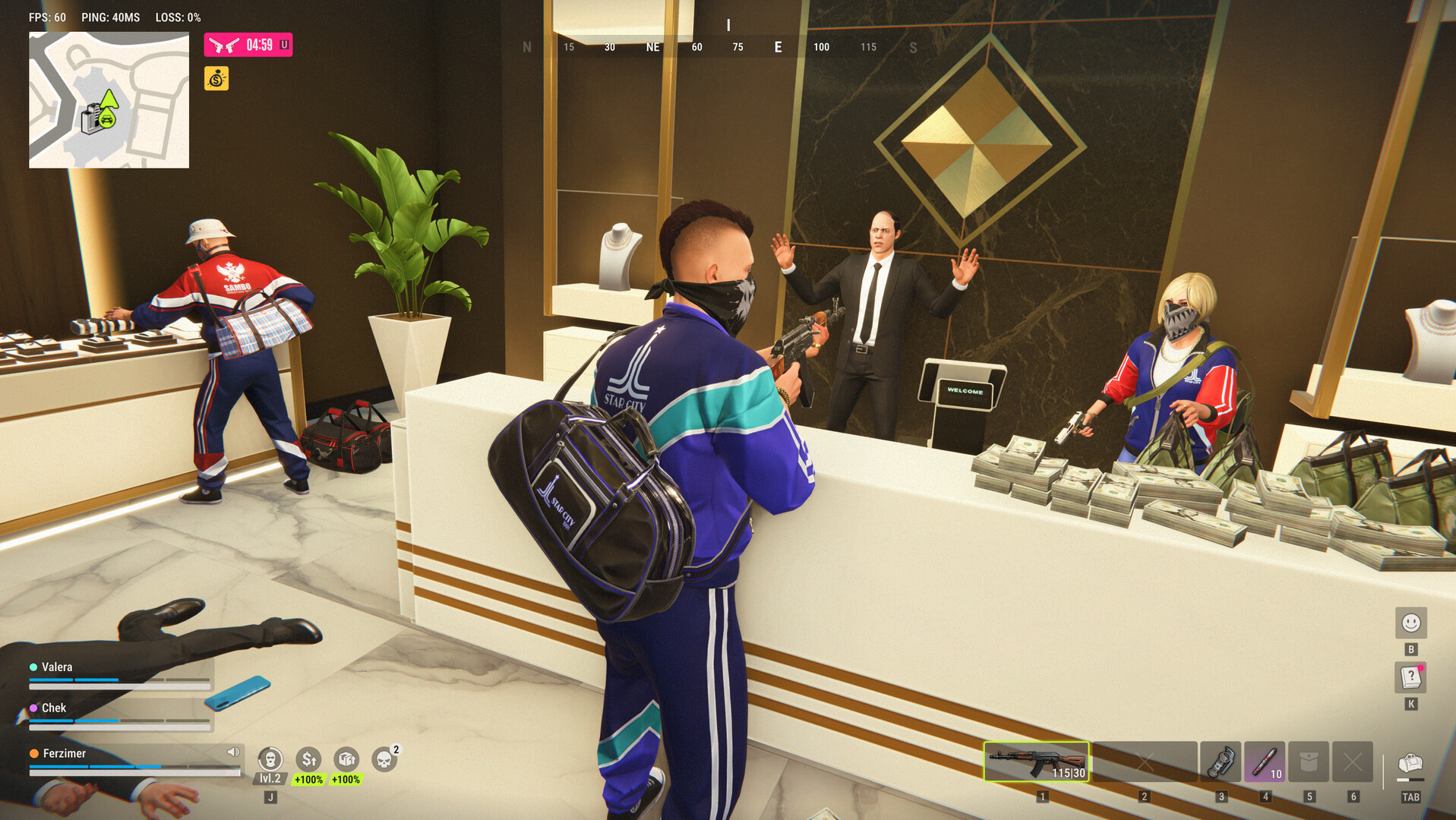
Official screenshot · Source: Steam store
The studio frames the game as a living criminal city, not a private mission list. Marketing copy puts about 5,000 real players in the same space, with every cop and every criminal controlled by a person who has their own plan. That density is why storage rules matter more than a perfect route. Someone can take what you just earned, and you can take theirs. Strength and cunning are the only levers the developers name.
The same pitch is blunt about failure. You can lose everything you are sitting on in a single minute. Open fights are often the wrong tool, because police are described as a real threat rather than set dressing. If a shootout is too hot, the intended play is to find another way to the same prize. Treat every ROB RUN loot run as temporary until it is split between a cash drop and a defended stash.
| What can go wrong | Who causes it | What you should assume |
|---|---|---|
| Death mid-robbery | Police or other criminals | Carried goods are at risk; the help snippet warns of a loss on death |
| Open fight in a crowd | Any nearby player with a gun | A 5,000-player city makes third parties likely |
| Raid on a rich base | Rival crews | Stored goods are not safe just because they left your pockets |
| Weekly reset | Server wipe cycle | A one-week climb can end with a fresh start |
| Betrayal inside a crew | Clan mates | Allies are valuable, but the setting assumes anyone can turn |
How Looty Bay heists actually start
The help center’s looting section answers the first practical question: how do you pull off heists in Looty Bay? Putting on a mask is what flags you as able to commit those robberies. It is not a cosmetic. Once the mask is on, police and other criminals are allowed to attack you. The public answer cuts off mid-sentence after “you’ll lose eve,” so treat death as a hard penalty on whatever you are holding, not as a slap on the wrist.
That rule changes route planning. A mask is a switch from “blending in” to “fair game.” You want the mask on only for the window where the robbery itself requires it, then off your face and out of the open as fast as the streets allow. The Steam description of the underworld lists bank robberies, raids on rival hideouts, police chases, and bloody shootouts as the daily loop. None of those are quiet by default. The quiet part is the decision before you commit.
There is no published payout table yet. Early Access is still ahead, and the developers say balance will move with live feedback. Do not build a route around a number you saw in a clip. Build it around the constraints that are already written down: a mask exposes you, death is expensive, and other players are hunting the same blocks.
| Decision | Lower-risk read | Higher-risk read |
|---|---|---|
| Mask timing | On only for the robbery window | Worn while you cross half the city |
| Fight or leave | Leave if police presence is thick | Trade shots in a crowded street |
| Target type | A job you can exit on foot | A spectacle that draws chases |
| Crew size | Enough people to watch exits | A crowd that cannot agree on a plan |
| Exit | Toward Lenny's or your base | Lingering to scoop extra bags |
Player experience already shows people testing quieter loops. A community clip titled around solo “purple (t2) key” looting frames key runs as a chill PvP-adjacent activity rather than a full crew assault. That is a report of how some players are practicing, not an official drop table. Until patch notes define tiers, treat purple tier-2 keys as a community label for a mid-tier locked route, and assume other players know the same doors.
Cash at Lenny's, goods in the base
The official split for ROB RUN loot is simple, and most new players will get it backward. The help center says you can only store cash at Lenny's. Stolen goods go in your base. Those are different vaults with different failure modes. Cash left in your pockets is not “saved.” Goods piled in a hideout are not “banked” either, because other players can raid you.
Use that split on every return trip. Convert what you can into cash and move that cash to Lenny's before you decorate the base. Park vehicles, workbenches, and safes only after the liquid money is off your character. The base is a workshop and a warehouse, not a bank. Lenny's is the bank, and it only accepts cash.
A practical loop looks like this:
- Finish the masked job and break contact before you sort the bag.
- Separate cash from physical stolen goods as soon as you are somewhere you can do it safely.
- Deposit cash at Lenny's on the way home, not after a victory lap.
- Put goods into base storage, then assume a raid timer has started in someone else’s head.
- Do not keep your best tools and your best goods in the same obvious room if the base tools let you spread them.
| Item type | Where it belongs | What still threatens it |
|---|---|---|
| Cash | Lenny's only | Dying or getting robbed before you arrive |
| Stolen goods | Your base | Raids by other players |
| Vehicles | Base storage | Attention that a flashy garage creates |
| Workbenches and safes | Built into the hideout | The same intruders who want the goods |
| Keys and run tools | On you only while you are using them | A death after the mask goes on |
If you die between the score and Lenny's, the help text’s warning applies to the trip, not just the vault door. The shortest legal-in-fiction path from the job to the cash counter is the highest-value “upgrade” you can make before any base cosmetic.
Bases that store goods without advertising them
The Steam feature list calls the hideout your castle. You build and upgrade it, store loot and vehicles, and place workbenches and safes. The next sentence undercuts the fantasy: the more lavish the refuge, the more intruders you attract. A rich base is a billboard. In a city where raids on rival hideouts are core fantasy, that billboard works.
A lean ROB RUN loot plan beats a trophy base during the first days of a wipe. Upgrade what keeps goods inaccessible and what lets you process them. Skip anything whose only job is to be seen from the street. Clans make this sharper. You can survive alone, the developers say, but you thrive by working together: crime families, roles, organized raids, territory, gang wars, and truces. A base that one person can watch all night is a different problem from a base that a crew leaves empty while they run a bank.
| Base choice | Helps you keep goods | Draws raiders |
|---|---|---|
| Safes and real storage | Yes | Only if the exterior screams wealth |
| Workbenches you actually use | Yes | Moderate, if smoke and noise are obvious |
| Extra vehicles on display | Sometimes | High |
| Lavish visual upgrades | Rarely | High, by the developers’ own warning |
| A crew on rotating watch | Yes | Lowers the payoff of a casual raid |
| Empty base during a citywide job | No | Peak risk |
Raid defense here is scheduling, not a magic wall. Someone has to be home, or the stash has to be small enough that a loss does not end the week. The game tells you both sides of that trade in one paragraph: store the loot, and expect company.
Solo keys, clans, and the one-week clock
The climb is short on purpose. The “till the server wipes us out” pitch says you can go from regular thug to boss of the largest organization on the server in a single week, then start over with new experience, allies, and a harder plan. That is a seasonal rhythm even if the exact wipe clock is not published as a timer. Hoarding for a month is the wrong mindset. Banking cash, finishing a base that can survive a few raids, and learning one repeatable route all fit inside seven days. A palace does not.
Solo play is allowed and, based on community reports, already happening. The purple tier-2 key clip is explicitly a solo session. Solo is the right shape for a key door when you want less voice chatter and a smaller footprint. It is the wrong shape when the job is a bank or a rival compound, because you cannot watch the door and the alley at the same time. The 5,000-player figure is marketing, but the design point is real: third parties show up.
Clans are the multiplier after you can survive a solo loop. Assign roles before you need them. One player handles the mask window and the bag. One watches police routes. One peels off toward Lenny's with cash so a single death does not zero the crew. Territory and truces matter only after you have something worth negotiating over. A truce with an empty base is small talk.
| Style | Best use | Weak spot | Loot habit that fits |
|---|---|---|---|
| Solo key run | Quiet tiered doors, learning spawns | No one to extract cash if you drop | Small bags, immediate Lenny's stop |
| Duo | One looter, one exit watch | Still fragile to a full police push | Split cash and goods at the door |
| Clan raid | Banks, rival bases, territory | Betrayal and loud timelines | Shared base rules and a cash runner |
| Opportunist | Third-party a fight you did not start | You become the next third party | Leave with less, sooner |
Community reports are not balance patches. If a video shows a purple key route working on a given day, assume other crews will camp it tomorrow. The developers have already said Early Access exists so live players can move balance, netcode, and content. A “chill” route is chill until the server learns it.
What Early Access will still change
ROB RUN is listed on Steam as coming to Early Access, with a planned release date of November 2026. The studio’s own answers say they expect roughly 6 to 12 months of Early Access, that the price is not planned to change when that period ends, and that the current build is meant to be a fully playable online game that still needs polish, balance, and more features. Occasional bugs are part of that pitch, not a surprise.
The full version, as they describe it, adds maps, modes, characters, customization, items, progression, rankings or achievements, better matchmaking, and network stability. Any of those can redraw routes. A new item tier can make today’s key irrelevant. A new map can move Looty Bay’s value. Rankings can make showy raids worth more than quiet cash. Read the ROB RUN page on Steam before you trust a month-old route guide, and check the Steam community hub or the studio’s Discord when patch notes land. The developers say those channels are how they want bug reports, feature ideas, and balance arguments.
The store page also notes Easy Anti-Cheat and a kernel-level anti-cheat requirement, plus a third-party EULA. That is a fairness tool for an economy where stealing from players is the game. It does not change stash rules. It does mean you should not expect unofficial clients or injected tools to be part of a serious loot plan. Play the client the store describes.
Language support on the store listing is broad for interface text, with full audio called out for English and Russian. If your crew mixes languages, call loot splits in the simplest words you share: cash, base, mask, leave. A missed call during a Looty Bay exit costs more than a fancy strategy name.
System requirements are modest for the genre but not tiny. The minimum listed is Windows 10 or later, a 64-bit CPU around an Intel Core i5-6600K or Ryzen 5 1600, 12 GB of RAM, and a GTX 1050 Ti, RX 580, or Arc A380 class GPU, with 20 GB of disk and broadband. Recommended steps up to something like an i5-9600K or Ryzen 5 3600, 16 GB of RAM, and an RTX 2070, RX 5700 XT, or Arc B570. DirectX 11 is the listed API. If your machine is on the minimum line, favor shorter runs. A stutter during a police chase is a loot-loss bug you cannot patch yourself.
| Topic | What is public now | How to use it |
|---|---|---|
| Release | Planned November 2026, Early Access | Wishlist and expect change |
| Early Access length | About 6–12 months | Recheck routes after major patches |
| Price after EA | Not planned to change | No need to “wait for a sale” based on their statement |
| Near-term content | Playable core, more maps and items later | Do not memorize unreleased tiers |
| Anti-cheat | Easy Anti-Cheat, kernel-level | Stick to the official client |
| AI disclosure | AI used for some graphic elements | Irrelevant to stash rules |
| PC floor | 12 GB RAM, 20 GB disk, DX11 | Leave headroom so chases do not hitch |
A few habits stay useful even when numbers move:
- Mask on, job done, mask off, then move.
- Cash to Lenny's before you touch base cosmetics.
- Goods in the base, with the building no richer than your defense.
- Solo for keys and scouting; crews for banks and compounds.
- Spend the week learning one route you can repeat after the wipe, not a stash you cannot carry into the next cycle.
The developers also note that AI is used for some graphic elements. That disclosure does not tell you where safes should sit. Ignore cosmetics that exist to look generated or expensive. Intruders are responding to wealth, not to how an asset was made.
FAQ
Where should I keep ROB RUN loot after a job?
Put cash at Lenny's. That is the only cash storage the help center names. Put stolen goods in your base, and remember that other players can raid that base. Anything still on your character is one death away from being someone else’s score.
Do I need a mask for every robbery?
For Looty Bay heists, yes, according to the help docs. The mask is what lets you commit those robberies, and it also lets police and other criminals attack you. Wear it for the job, not for the commute.
Is a bigger base safer?
Not by itself. You can add storage, vehicles, workbenches, and safes, which helps you hold goods. The same official description warns that a lavish hideout pulls more intruders. Match the building to the people who can actually defend it this week.
Will routes from launch videos still work in Early Access?
Treat them as player experience, not as a patch. The game is planned for Early Access around November 2026, for roughly 6 to 12 months, with more maps, items, and balance changes still ahead. A solo purple tier-2 key run may be a fair way to learn the city. It is not a promise that the door, the tier, or the payout will stay put.
Related Guides
ROB RUN bank robberies: Heist and Loot Guide
Learn how ROB RUN bank robberies work, from masks and crew roles to selling loot, storing cash, and managing Notoriety in Looty Bay.
ROB RUN raids on rivals' hideouts: full guide
Learn how ROB RUN raids on rivals' hideouts work, from decoders and timing to crew roles, loot priority, and base defense before the wipe.
ROB RUN trade point Guide for Safer Cashouts
Turn heist loot into cash at a ROB RUN trade point. Compare city sales, base safes, notoriety, and cop risk in Looty Bay.
ROB RUN quick decisions for Weekly Wipe Survival
Learn ROB RUN quick decisions for clans, raids, hideouts, and weekly wipes so you keep loot when 5,000 players can take it.
ROB RUN closed alpha: playtest, date, and what we know
ROB RUN is still unreleased. See the Steam playtest, November 2026 Early Access plans, PC specs, and what closed alpha clips leave unconfirmed.